

Key Points: Learn how to identify when you should report an environmental spill and the appropriate governing bodies to report to.
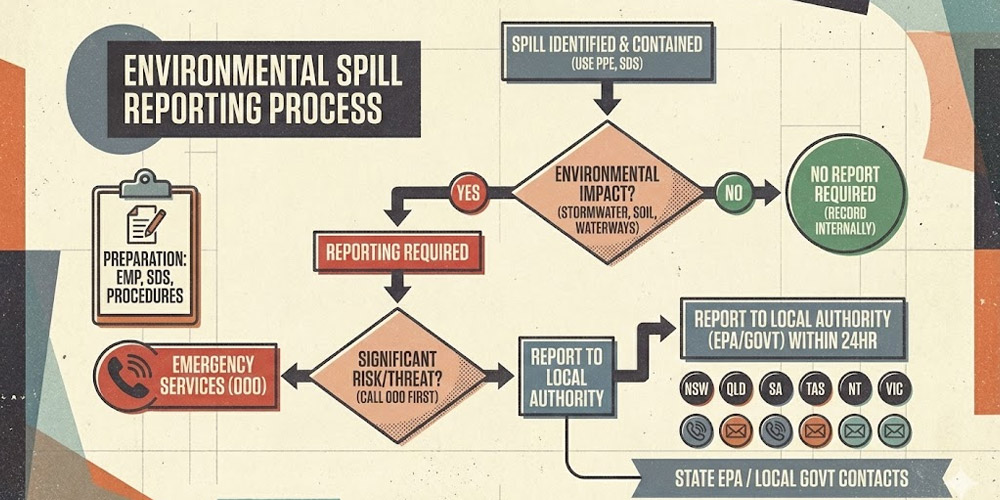
Once a spill has been identified, assessed and using the correct PPE equipment and procedures based on your spill kit’s SDS, you may be legally obligated to report the spill to your local authority.
As a precaution and to assist with reporting best practices, if the storage of hazardous materials is a regular activity within the workplace, the following should already be in place:
- Information regarding hazardous liquid materials stored within the workplace is recorded and accessible, including volume and location of stored liquids and safety data sheets
- Regulations governing the safe storage of hazardous liquid materials are well established, and correct procedures are followed, including an understanding of the legal obligations of the business for safe handling, spill clean-up and reporting
- An understanding of the information that should be contained within a report regarding a spill activity (if required), or where to access forms required to be completed when reporting a spill activity, the information that should be contained within the report and who it should be reported to.
When Should You Report A Spill?
All pollution incidents of any nature should be reported as quickly as possible to your local authority.
This includes liquid spill events that have an environmental impact, e.g. contaminants as a result of the liquid spill entering the stormwater network or local waterways and contamination of soil.
If the spill has been contained without any negative consequences for the environment, either now or in the future, you are not under any obligation to report the spill activity.
Who Should You Report A Liquid Spill To?
If the liquid spill is of a significant nature and poses a potential risk, your first obligation is to call emergency services (000).
If, however, the liquid spill does not pose a significant threat but has been deemed a ‘pollution event,’ you are obliged to report the details of the spill to your local authority within your state, in most cases within 24 hours.
For example, NSW Business owners have a duty to report incidents of this nature under section 148 of the Protection of the Environment Operations Act 1997 (POEO Act).
Depending on your location, you will be required to report the liquid spill event to either the Environmental Protection Agency (EPA) or the local government. Please see below for useful contact information for each state:
(*In many cases, pollution activity reporting forms will also be available on the local authority’s website)
| New South Wales | Ph: 131 555 Email: info@environment.nsw.gov.au |
| Queensland | Ph: 1300 130 372 Email: pollutionhotline@des.qld.gov.au |
| South Australia | Ph: (08) 8204 2004 or 1800 623 445 (non-metropolitan callers) Email: epainfo@sa.gov.au |
| Tasmania | Ph: 1800 005 171 Email: incidentresponse@environment.tas.gov.au |
| Northern Territory | Ph: 1800 064 567 (24 hr Pollution Hotline) |
| Victoria | Ph: 1300 372 842 Email: contact@epa.vic.gov.au |
| Western Australia | Ph: 1300 784 782 Email: pollutionwatch@dwer.wa.gov.au |
Summary
Ideally, all businesses that may have an impact on the environment in any capacity should have an Environmental Management Plan (EMP) in place. An EMP will outline your responsibilities when it comes to reporting the impacts of a liquid spill in the workplace and to whom the incident should be reported.
Preparation in the event of a hazardous liquid spill is always the best course of action for business owners who store potentially hazardous materials of any nature. Good preparation can prevent spills occurring in the first place, improve your response times (reducing the impact of the spill), and minimise potential threats to staff and/or equipment.