


What is bunding?
Bunding is a form of secondary containment, an impervious physical barrier designed to prevent liquids, such as oil, fuel, and chemicals, from escaping into the surrounding environment in the event of a spill or leak. Its purpose is to stop spilled liquids from reaching stormwater drains, soil, groundwater, or waterways.
When an area is described as bunded, it means it has been intentionally designed to contain the largest spill that could occur within that space.
Common examples of bunded areas include:
- Drum storage areas with floor bunding
- Bunded pallets holding chemical drums or IBCs
- Wash-down areas with bunded perimeters
Unsure What Your Site Requires?
Speak with our team before committing to equipment or installation. We’ll help confirm the right containment, washdown, or stormwater solution for your site.
- Leased, temporary or fixed site conditions
- Trade waste or EPA compliance questions
- Need confirmation before purchasing or installing
No obligation • Compliance-focused advice tailored to your site
Liquids that require bunding
- Oils and lubricants
- Fuels and hydrocarbons
- Chemicals and hazardous liquids
These substances are commonly stored or handled in drums, tanks, IBCs, or plant equipment where leaks, overfilling, or equipment failure can occur.
Workplace health and safety
While bunding’s primary purpose is to prevent environmental damage and reduce the scale and cost of clean-up activities. Effective bunding also helps to:
- Reduce slip and fall hazards
- Limit fire and explosion risks
- Minimise worker exposure to hazardous substances
Contained spills are safer and easier to manage.
Regulatory compliance
Australian environmental regulators expect businesses handling liquids to implement preventative containment measures.
Failure to adequately contain spills can result in:
- Operational disruption and reputational damage
- EPA enforcement action
- Clean-up and remediation orders
- Financial penalties and fines
Key point: A bunded area exists for containment only, not treatment or clean-up.
Typical bunded area layouts
Bunded areas are commonly used around:
- Drum storage areas
- IBC storage zones
- Plant and equipment handling liquids
- Wash bays and wash-down areas
- Decanting or transfer points
While layouts vary, the containment principle remains the same.
High-level types of bunded areas
Bunded areas may be formed using:
- Bunded pallets – self-contained units with integrated sump capacity
- Floor bunding – raised kerbing installed on existing slabs
- Concrete bunds – permanently constructed containment walls
These approaches describe how bunding is formed, not whether it meets capacity requirements.
Bunding Requirements in Australia (The 110% Rule Explained)
In Australia, regulators focus on whether a spill can be completely contained on site without reaching soil, stormwater, or waterways.
While requirements vary by state and industry, environmental authorities apply a consistent compliance principle across Australia.
The 110% rule
Australian EPA and Standards
Australian regulators, including EPA NSW, refer site operators to applicable Australian Standards (such as AS 1940 – Storage and Handling of Flammable and Combustible Liquids) when determining capacity requirements.
In practice, this means a bund must be capable of containing at least 110% of the volume of the largest container stored, or 25% of the total stored volume, whichever is greater, to meet accepted secondary containment expectations.
Supporting government references
EPA Victoria – Liquid storage and handling guidelines
https://www.epa.vic.gov.au/liquid-storage-and-handling-guidelines
NSW EPA – Bunding requirements at liquid waste treatment facilities
https://www.epa.nsw.gov.au/your-environment/waste/industrial-waste/hazardous-and-liquid-wastes/bunding-requirements-at-liquid-waste-treatment-facilities
EPA Tasmania – Bunding and Spill Management Guidelines (PDF)
https://epa.tas.gov.au/documents/bunding_and_spill_management_guidelines_dec_2015.pdf
Bund capacity, displacement & common mistakes
Bunding compliance is determined by usable liquid capacity, not just the physical size of the bunded area. * This is where many sites fall into non-compliance without realising it.
Bund capacity vs liquid volume
Bund capacity refers to the actual volume of liquid the bund can hold, not the gross internal dimensions of the bund walls.
What matters is:
- The net available volume, after accounting for displacement from items stored inside the bund
Any object inside the bund that occupies space reduces the volume available to hold spilled liquid.
Displacement explained
Consider a bund used to store one 200-litre drum:
- Compliance requirement (110% rule):
220 litres minimum containment
However:
- The drum displaces volume inside the bund
- If the bund’s internal volume is exactly 220 litres before the drum is placed inside, it is non-compliant
Why?
- The drum occupies space
- The bund can no longer physically hold 220 litres of liquid
To be compliant, the bund must have sufficient extra capacity to account for both:
- The spill volume, and
- The displacement caused by the drum
Unsure What Your Site Requires?
Speak with our team before committing to equipment or installation. We’ll help confirm the right containment, washdown, or stormwater solution for your site.
- Leased, temporary or fixed site conditions
- Trade waste or EPA compliance questions
- Need confirmation before purchasing or installing
No obligation • Compliance-focused advice tailored to your site
Common bunding mistakes
The most frequent compliance issues include:
- Ignoring displacement from drums, pallets, or equipment
- Measuring wall height × floor area only
- Installing floor bunding without checking total volume
- Assuming manufacturer-stated capacity applies after loading
- Failing to reassess capacity when storage layouts change
Key takeaway
Bund capacity is about what the bund can actually hold during a spill, not what it looks like on paper.
If the required spill volume cannot be contained after displacement, the bund does not meet capacity requirements, regardless of intent.
Types of bunding systems
There are multiple types of bunding systems used for spill containment. Each is designed for different site conditions, storage methods, and risk levels. No single system is suitable for every application.
Bunded spill pallets

What they’re for
Self-contained bunded units designed to hold drums or IBCs above an integrated sump.
Pros
- Built-in, known containment capacity
- Quick to deploy with minimal setup
- Suitable for indoor and outdoor use
- Easy to relocate if site layouts change
Cons
- Limited to specific container sizes and quantities
- Not suitable for vehicle traffic
- Capacity is fixed and cannot be expanded
Rubber floor bunding
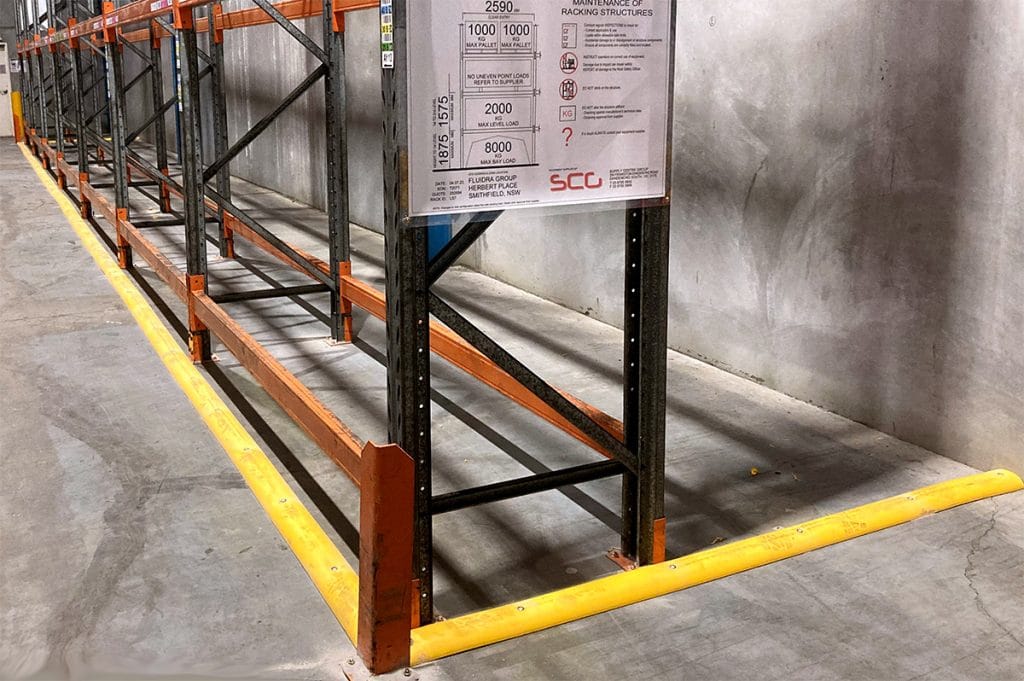
What it’s for:
Permanent or semi-permanent raised barriers installed on existing floors to create a bunded area.
Pros
- Low-profile and forklift-friendly
- Suitable for vehicle and foot traffic
- Can be retrofitted to existing slabs
- Clean, defined containment zones
Cons
- Requires correct installation and sealing
- Capacity depends on floor area and wall height
- Not easily reconfigured once installed
Flexible floor bunding
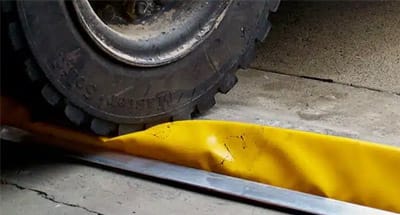
What it’s for:
Collapsible bunding that forms a temporary containment area on flat surfaces.
Pros
- Quick to deploy and remove
- Lightweight and portable
- Can be driven over when empty
- Minimal site preparation required
Cons
- Limited height and capacity
- Not suitable for permanent installations
- Requires careful setup to maintain seal integrity
Ideal applications
- Temporary worksites
- Short-term containment needs
- Low-volume spill risk areas
Portable bunding
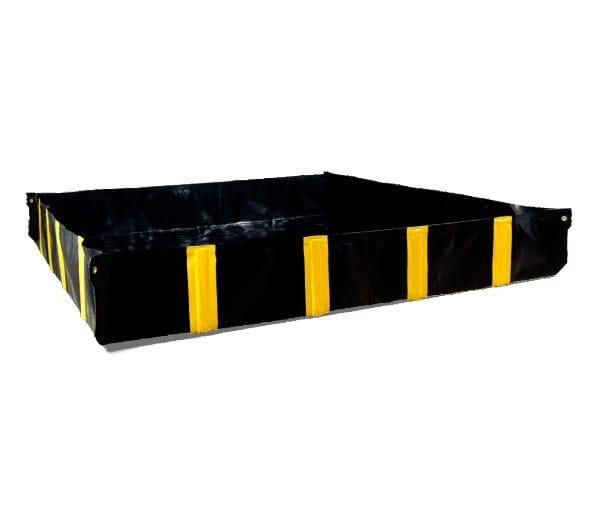
What it’s for:
Relocatable bunds designed to provide temporary or semi-permanent spill containment.
Pros
- No permanent installation required
- Flexible sizing options
- Suitable for changing site layouts
- Can be reused across multiple locations
Cons
- Requires flat, stable surfaces
- Capacity may be lower than fixed systems
- Setup quality affects performance
Ideal applications
- Construction sites
- Temporary storage zones
- Mobile plant and maintenance activities
Temporary / emergency bunding

What it’s for:
Rapid-deployment systems used to contain spills during incidents or unplanned events.
Pros
- Fast response capability
- Complements spill kits
- Useful for emergency containment
Cons
- Not designed for long-term storage
- Limited capacity and durability
- Requires trained staff to deploy correctly
Ideal applications
- Spill response scenarios
- Equipment failure events
- Interim containment until permanent controls are in place
Installation, maintenance & inspection
Bunding must be correctly installed, regularly inspected, and maintained to remain compliant over time.
Installation
Bunding should be:
- Installed in line with manufacturer instructions
- Positioned on stable, level surfaces
- Properly sealed at joints, corners, and penetrations
Any gaps, cracks, or seal failures are treated as containment failures, regardless of capacity.
Inspection
Bunded areas should also be inspected:
- As part of routine site checks
- After spills or incidents
- Following layout changes or damage
Inspection frequency should reflect spill risk and site activity.
Rainwater and ongoing compliance
For outdoor bunding, rainwater must be managed without reducing available spill capacity, and contaminated water must not be discharged without approval.
A bund that was compliant at installation can become non-compliant over time due to layout changes, added containers, or poor housekeeping
The right Bund Solution for Your Requirements
Choosing bunding is a compliance and risk decision, not a space or cost decision. The correct solution depends on how liquids are stored, handled, and moved on site.
Key factors
- Indoor vs outdoor use
Outdoor bunding must manage rainwater and runoff. Indoor bunding must contain spills without relying on drainage. - Vehicle and equipment traffic
Areas with forklifts or mobile plant require low-profile or traffic-rated bunding. Static storage areas do not. - Temporary vs permanent operations
Temporary activities may suit portable systems. Permanent storage typically requires fixed or engineered bunding. - Chemical compatibility
Bunding materials must be compatible with the liquids stored. Material failure is treated as non-compliance. - Compliance risk
Higher volumes, hazardous liquids, proximity to drains, and regulatory scrutiny require more robust containment.
The right bunding solution meets capacity requirements, suits site conditions, and remains compliant over time.
If you’re unsure which bunding approach suits your site, get in touch with a bunding expert today.
FAQs
What does bunding mean?
Bunding refers to a physical containment barrier designed to hold liquids if a spill or leak occurs. Its purpose is to prevent liquids from escaping into surrounding areas, drains, soil, or waterways.
Is bunding required under Australian regulations?
While requirements vary by state, Australian environmental regulators generally expect bunding to be in place wherever oils, fuels, or chemicals are stored or handled and a spill could cause environmental harm. Bunding is treated as a standard preventative control.
What is the 110% bunding rule?
The 110% rule requires a bund to contain at least 110% of the volume of the largest container stored, or 25% of the total stored volume, whichever is greater. This approach aligns with EPA guidance and Australian Standards for secondary containment.
Does bund capacity include the containers stored inside it?
Yes. Displacement must be accounted for. Drums, IBCs, pallets, or equipment inside the bund reduce the volume available to contain spilled liquid. Capacity must be based on the net usable volume, not empty dimensions.
Are spill kits a replacement for bunding?
No. Bunding is a preventative measure, while spill kits are used after a spill has occurred. Regulators do not consider spill kits alone to be adequate where bunding is reasonably practicable.