
Warehouse environments storing fuels, oils, chemicals or hazardous liquids require compliant secondary containment that withstands forklift and vehicle traffic. Trade Enviro’s warehouse floor bunding provides low-profile, trafficable spill containment designed to prevent liquid spills while maintaining maximum warehouse efficiency.
Spill Containment Requirements in Warehouse Environments
In warehouses, bunding is typically required in two types of areas:
- Fixed storage zones where drums, IBCs or equipment remain in place
- Access points such as doorways or crossings where vehicles must pass through
These two situations usually require different floor bunding solutions:
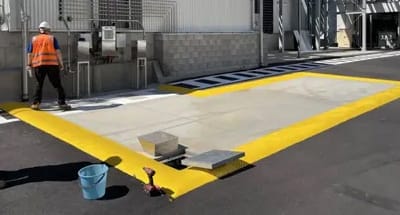
Rubber Floor Bunding
Creates a low-profile containment zone in areas where spills need to be controlled without restricting vehicle or equipment movement.
- Commonly used in warehouses, workshops, and wash bays
- Suitable for permanent containment areas with occasional vehicle or forklift access
- Used to contain oils, fuels, chemicals, and wash water
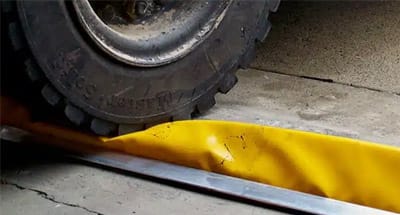
Flexible Floor Bunding
Drive-over containment barriers for spill control in areas with regular vehicle and forklift traffic.
- Designed for access points, and high-traffic industrial floors
- Collapsible profile allows vehicles and forklifts to pass without removal
- Commonly used where permanent bunding is impractical or disruptive
The right choice depends on how the area is used and how vehicles move through it.

Heavy-Duty Rubber Floor Bunding
Rubber floor bunding is typically used for permanent warehouse containment zones where forklifts and pallet jacks operate daily.
It is best suited to:
- Full perimeter containment areas
- Drum and IBC storage zones
- High-traffic forklift aisles
- Wash-down and maintenance areas
Because rubber bunding is mechanically fixed and highly durable, it provides long-term structural integrity under load. It is generally the preferred option for warehouses requiring permanent, heavy-duty containment.
Read More About Our Rubber Floor BundingFlexible Drive-Over Bunding
Flexible bunding is designed to compress under vehicle load and return to shape after traffic passes.
It is typically used for:
- Doorways and roller doors
- Access thresholds
- Transitional containment zones
- Areas where minimal obstruction is critical
Flexible bunding is often selected where maintaining uninterrupted vehicle movement is the priority.
Read More About Our Flexible Floor BundingCompare Warehouse Floor Bunding Options
| Feature | Rubber Floor Bunding | Flexible Drive-Over Bunding |
|---|---|---|
| Installation Type | Permanent, mechanically fixed | Fixed or semi-permanent |
| Vehicle & Forklift Use | Designed for forklifts, pallet jacks and industrial vehicles | Designed for forklifts and vehicles crossing containment edges |
| Profile | Sloped, heavy-duty rubber profile | Compressible drive-over profile that flattens under load |
| Long-Term Durability | High – suited to constant industrial load | Long-Term Durability Long-term industrial installation Designed for repeated vehicle crossings |
| Full Perimeter Containment | Commonly used for full containment zones | Often used at edges or transitional sections |
| Doorway / Threshold Use | Suitable with ramps | Highly suited |
| Maintenance | Minimal when correctly installed | Inspect high-traffic zones periodically |
Use-Case Comparison
| Warehouse Scenario | Recommended Option |
|---|---|
| Permanent drum storage zone | Rubber Floor Bunding |
| Defined forklift operating zone | Rubber Floor Bunding |
| Roller door threshold containment | Flexible Drive-Over Bunding |
| Wash bay entry / exit | Flexible Drive-Over Bunding |
| Mixed-use warehouse environment | A combination of both |
Compliance & Capacity: What you Need To Know
In most Australian industrial environments, bunded areas are expected to contain at least:
- 110% of the largest container stored, or
- 25% of the total stored volume (whichever is greater)
When installing bunding in a warehouse, it is important to consider:
- The number and size of drums or IBCs stored
- Whether containers displace usable containment volume
- Proximity to stormwater drains
- Whether wash-down activities occur in the area
A bunded area that cannot physically contain the required spill volume may be considered non-compliant, regardless of intent.
Typical Warehouse Applications
Drum & IBC Storage Areas
Create defined containment zones around stored liquids to prevent spread across concrete slabs.
Forklift Operating Zones
Maintain containment without restricting daily vehicle movement within defined areas.
Roller Doors & Access Points
Install drive-over bunding at thresholds where liquids may otherwise escape.
Wash-Down & Maintenance Areas
Help contain wash water, oils and contaminants before they reach stormwater systems.
Refuelling & Decanting Points
Provide secondary containment where liquid transfer occurs.
In many warehouse environments, a combination of rubber and flexible bunding is used to suit different parts of the facility.
Choosing the Right Warehouse Floor Bunding
The correct bunding solution depends on how liquids are stored, how vehicles move through the space, and whether containment areas are permanent or transitional.
Rubber floor bunding is typically selected for defined, long-term containment zones in high-traffic warehouse environments.
Flexible drive-over bunding is often used at doorways, access points and transitional edges where uninterrupted vehicle movement is critical.
In many facilities, both systems are used together to create a practical, compliant containment layout.
If you’re unsure which configuration best suits your warehouse, our team can provide practical, site-specific guidance.