

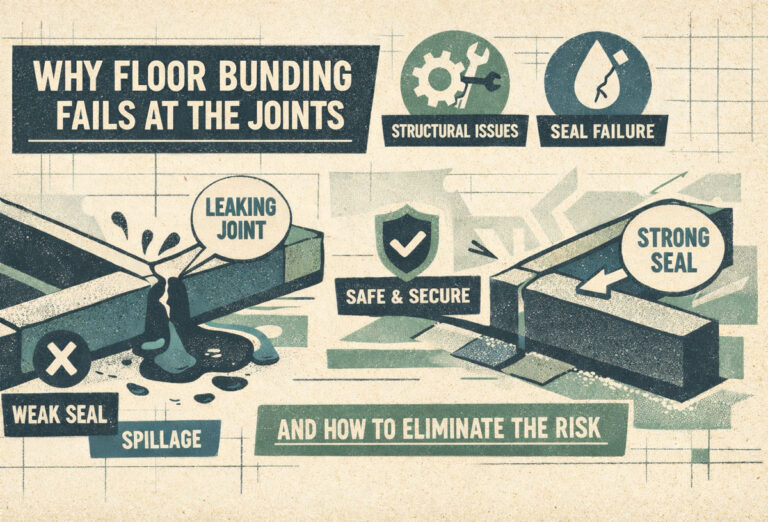
When floor bunding systems experience performance issues, it is most commonly at the joints.
Whether installed in workshops, wash bays, warehouses, fuel storage areas, or industrial facilities, in sectional bunding systems, the joint is typically the most mechanically sensitive point.
And the number of joints in your installation directly affects your long-term risk.
The Hidden Risk in Multi-Piece Floor Bunding
Some floor bunding systems are manufactured in longer continuous lengths, while others are supplied in short modular sections.
On the surface, that might not sound like a problem.
But let’s break this down practically.
Example: 5 metre run
- 5m continuous length = 0 joins
- 1m sections = 4 joins
That’s four separate bond lines that must:
- Be aligned perfectly
- Be sealed perfectly
- Remain intact under traffic and load
Each joint becomes a potential leak path.
Example: 10 metre run
- 5m engineered lengths = 2 joins
- 1m sections = 9 joins
That’s nine additional potential failure points.
From an engineering standpoint, increasing joint count increases failure probability. It’s basic risk mathematics.
More joints = more exposure.
Why Joints Fail Over Time
Most flat-base rubber bunding systems rely on a surface-applied sealant between two flat edges.
This creates a thin bond line sitting directly on the slab.
Over time, real-world conditions introduce stress:
- Vehicle traffic causes lateral shear
- Forklifts and pallet jacks create compression and rebound
- Thermal expansion causes movement
- Cleaning chemicals attack exposed sealant edges
- Minor slab imperfections create uneven pressure
When sealant is applied in a thin surface smear without containment, it can fatigue, crack, or separate.
If bond integrity is compromised, containment performance may be affected. And in containment applications, even small leaks matter.
The Engineering Difference: Extruded Glue Channels
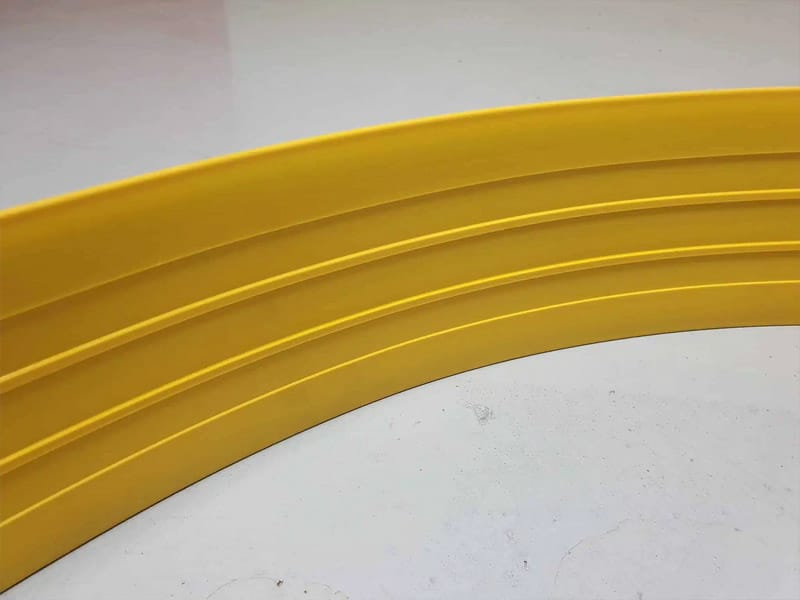
At Trade Environmental, our rubber floor bunding is designed with integrated extruded glue channels.
Instead of relying on a thin exposed bead of sealant, the adhesive sits within a recessed channel that:
- Maintains consistent sealant depth
- Protects the bond from lateral shear
- Provides mechanical containment
- Reduces exposure to surface abrasion
- Creates a stronger, more stable joint over time
The result is not just a glued seam – but an engineered joint.
Unsure What Your Site Requires?
Speak with our team before committing to equipment or installation. We’ll help confirm the right containment, washdown, or stormwater solution for your site.
- Leased, temporary or fixed site conditions
- Trade waste or EPA compliance questions
- Need confirmation before purchasing or installing
No obligation • Compliance-focused advice tailored to your site
Installation Efficiency Matters To
Beyond long-term performance, joint count affects installation quality.
More pieces mean:
- More alignment variables
- More cutting and trimming
- More potential for uneven joins
- More labour time
- Greater chance of human error
Fewer joins mean:
- Faster installation
- Cleaner finish
- Reduced variability
- Lower lifetime maintenance risk
Risk vs Price Per Metre
It’s easy to compare floor bunding systems on a “price per metre” basis.
But containment systems should be assessed on risk per joint.
Ask yourself:
- How many joins are in my installation?
- How is the sealant contained?
- Is the joint mechanically supported?
- How will this perform under traffic in 2–5 years?
In industrial environments, reliability matters more than short-term material savings.
The Practical Question
For a 10 metre bund run:
Would you prefer:
- 9 exposed flat-base seal joints or
- 2 engineered joints with integrated glue channels?
Floor bunding is not just a rubber barrier. It’s a containment system. And containment systems should be designed to eliminate potential points of failure – not multiply them.
Built for Real Industrial Conditions
Trade Environmental floor bunding systems are designed specifically for:
- Workshops
- Wash bays
- Warehouses
- Fuel handling areas
- Mining and heavy industry
- Industrial transport yards
Where traffic, movement, and operational wear are normal – not exceptions. If you’re specifying or installing floor bunding, it pays to understand where failures occur before they occur.
Need help selecting the right bunding system?
We provide:
- Technical advice
- Joint design guidance
- Spill risk assessments
- Custom lengths to minimise join count
- Installation support
Contact Trade Enviro to discuss a floor bunding solution engineered for durability, not just compliance.