

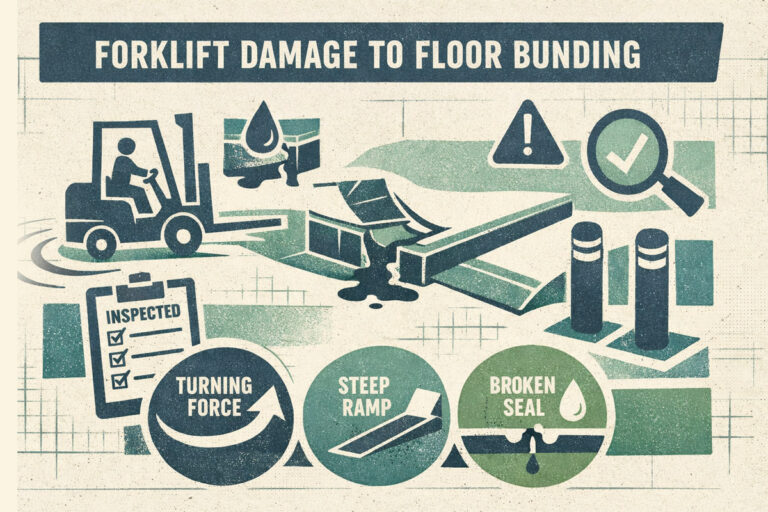
You installed floor bunding last quarter.
It looked compliant.
It looked sealed.
Job done.
Then a loaded forklift turns too tightly at the bund edge.
The edge lifts.
The adhesive tears.
The seal opens up.
Your containment perimeter now has a gap. What looked like a finished installation is now a containment risk.
Under the WHS Regulation 2011 (Qld), risk controls must remain effective. If forklift traffic has damaged the bund line, compliance can be compromised just as quickly as containment.
Damaged floor bunding is not just a maintenance issue. It is a spill risk.
What Inspectors Check First
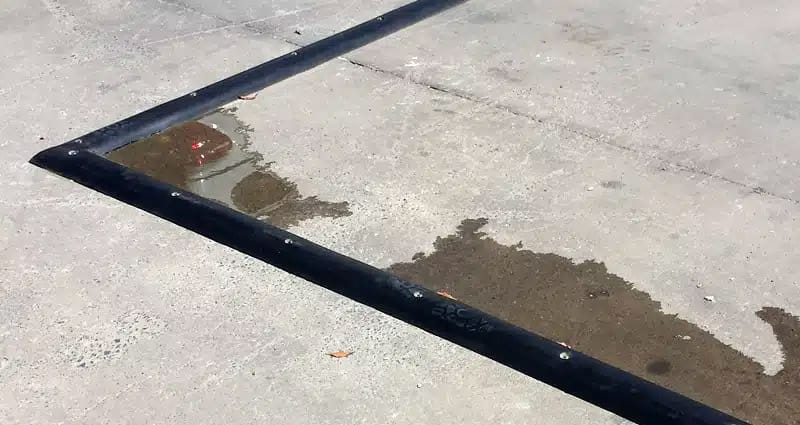
When bunding is installed in a traffic area, inspectors are not just checking whether it exists. They are looking at whether the containment line is still intact and still capable of doing its job.
That usually means checking for:
- a continuous, liquid-tight perimeter
- visible impact damage along the bund edge
- lifting, tearing, or adhesive failure
- gaps at thresholds, joins, or corners
- signs that the bund has been inspected and maintained
If forklift traffic has broken the seal, the issue is no longer cosmetic.
Once the perimeter is compromised, so is the containment.
The 3 Most Common Failure Points
1. Sharp Turns Across the Rubber Floor Bund Edge
Loaded forklifts, especially with solid tyres, create high lateral force when turning tightly over a bund line.
That sideways pressure can lift the edge, stress the adhesive, and start tearing the seal away from the floor.
2. Incorrect Ramp Slope
If the access ramp is too steep, forklifts hit the bund harder on entry and exit.
That repeated impact increases stress on the bund edge, weakens the seal over time, and raises the chance of undercarriage strikes in busy traffic zones.
3. No Mechanical Protection at High-Risk Points
Corners, entries, and exposed bund ends are often the first areas to get hit.
Without bollards, guards, or other protection, those impact points take direct traffic damage and fail much earlier than the rest of the containment line.
Unsure What Your Site Requires?
Speak with our team before committing to equipment or installation. We’ll help confirm the right containment, washdown, or stormwater solution for your site.
- Leased, temporary or fixed site conditions
- Trade waste or EPA compliance questions
- Need confirmation before purchasing or installing
No obligation • Compliance-focused advice tailored to your site
How to Reduce Floor Bunding Failure in Traffic Areas
In high-traffic zones, preventing failure usually comes down to protecting the bund line from repeated impact and choosing a system suited to the traffic conditions.
That usually means:
- directing forklifts to cross bunds straight-on instead of turning across the edge
- using bund ramps that reduce impact at traffic entry points
- inspecting bunding regularly in busy areas for lifting, tearing, or seal failure
- repairing minor damage early before the perimeter separates
- reviewing whether the installed bund profile is actually suited to forklift traffic
Containment in a traffic area must be maintained, but it also needs to be specified correctly from the start.
If forklifts cross the bund line every day, the issue is often not just damage. It is product suitability.
What Usually Needs to Change
If floor bunding is failing under forklift traffic, the answer is rarely just another tube of adhesive.
The real fix usually involves reviewing the full traffic crossing detail, including:
- whether the bund profile is suitable for regular vehicle or forklift movement
- whether bund ramps are needed to reduce repeated impact at crossing points
- whether traffic is crossing the bund straight-on or turning across the edge
- whether high-stress areas need additional protection or layout changes
- whether the damaged section should be replaced before the perimeter fails completely
In traffic zones, floor bunding needs to be selected and installed for the way the site actually operates – not just for initial containment.
Where forklifts cross the bund line every day, impact resistance and transition design matter just as much as the seal itself.
Compliance
Floor bunding in traffic areas is not a set-and-forget control.
Under the WHS Regulation 2011 (Qld), control measures must be maintained so they remain effective, including being fit for purpose and suitable for the nature and duration of the work.
Under Queensland’s Environmental Protection Act 1994, businesses also have a General Environmental Duty to take all reasonable and practicable measures to prevent or minimise environmental harm. If a damaged bund line allows a spill to escape containment, that can become more than a maintenance issue.
Installation alone is not enough. In high-traffic areas, maintenance and ongoing suitability are part of compliance.
Need Advice?
If forklifts cross the containment line every day, the bunding system on your site needs to suit the traffic conditions. We can help you review the area and recommend a floor bunding system that suits the site layout, traffic pattern, and containment risk. Get in touch today.