

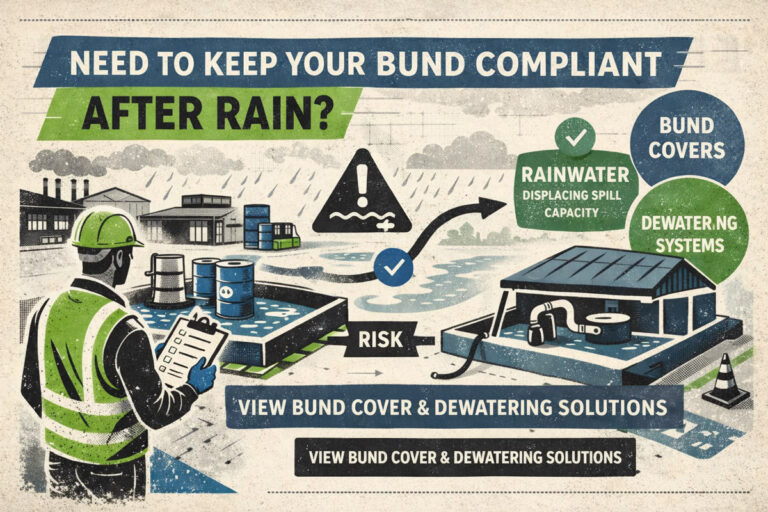
A Storm Passes Through. Your Bund Is Full.
You inspect your outdoor bund after heavy rain.
It’s full of water.
If a container ruptured right now, there would be no capacity left to contain the spill.
Under AS 1940:2017, the required bund capacity must be available at all times.
Why Rainwater Creates a Compliance Risk
A bunding system is designed to hold a specific emergency volume – typically the larger of:
- 110% of the largest container, or
- 25% of total stored volume
This capacity must remain available at all times.
When rainwater fills an outdoor bund, it replaces the emergency containment volume that would be required if a tank, drum or IBC failed.
A bund that appears intact can therefore become non-compliant simply because rainfall has occupied the containment space.
This is why inspectors often check bunds after heavy rainfall events.
What Inspectors Check
- Is required capacity available?
- Has rainwater displaced chemical capture volume?
- Is there a dewatering protocol?
- Is stormwater protected from contamination?
Key Point: Inspectors view unmanaged rainwater as a predictable risk – not an excuse.
Why This Happens So Often
Outdoor bunds are rarely inspected daily.
Rainwater can accumulate quickly during storms and remain in the bund long after rainfall has passed.
By the time staff notice the water level, the bund may already have lost most of its available containment capacity.
Many facilities only discover the problem when preparing for:
- Environmental audits
- EPA inspections
- Dangerous goods compliance checks
At that point, the issue becomes urgent, and must be corrected immediately.
The 3 Most Common Failure Points
1. Leaving Bunds Uncovered
Open bunds collect rainfall continuously.
2. Manual Drain Valves Left Open
Operators drain water and forget to close valves – creating uncontrolled discharge risk.
3. Pumping Oily Water to Sewer
Discharging contaminated water can breach local trade waste limits (e.g., Urban Utilities).
Managing Rainwater in Bunded Areas
Outdoor bunds should always include a simple rainwater management procedure.
Common approaches used on compliant industrial sites include:
• Routine inspection schedules – bunds checked after major rainfall events
• Controlled drainage procedures – water inspected for contamination before release
• Bund covers or roofing – preventing rainfall entering the containment area
• Dedicated sump points – allowing safer removal of accumulated water
• Stormwater protection measures – ensuring contaminated water cannot reach stormwater drains
Where bunds protect fuel, oil or chemical storage, these controls should be includedd as part of the site’s spill response or environmental management plan.
Without a defined process, bund capacity can easily be lost between inspections.
What Hardware Can Help Solve This
- Heavy-duty PVC bund covers
- Hardcover bund systems
- Sensor-driven automated bund dewatering systems
- Oil-water separators for compliant discharge
What To Do If Your Bund Is Full After Rain
Ok, let’s say a bund has filled with rainwater, action should be taken immediately to restore containment capacity.
Typical steps include:
- Stop any chemical transfers or deliveries until capacity is restored.
- Inspect the water surface for contamination.
- Test or visually confirm water quality before discharge where required.
- Pump or drain clean rainwater in accordance with site procedures.
- Record the inspection as part of site compliance documentation.
The key objective is simple:
Restore the full containment volume as quickly as possible.
Need Help?
If rainwater is compromising your bund capacity, talk to us about bund covers and dewatering solutions that help keep your site compliant.