

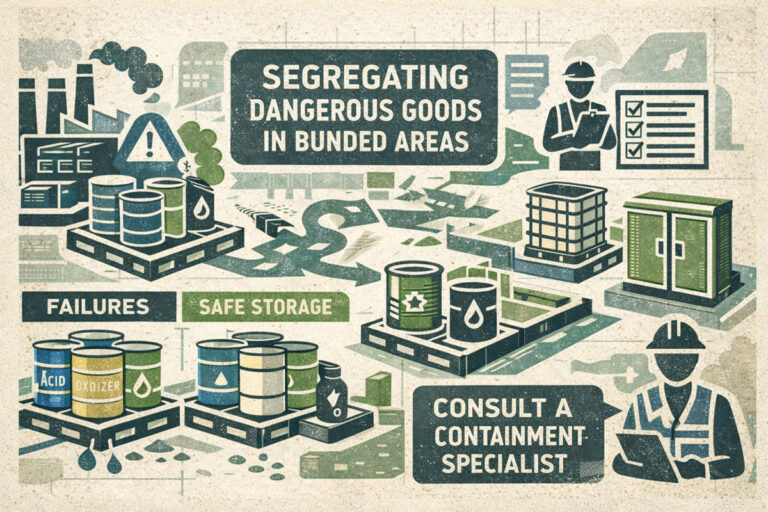
What Gets Sites in Trouble
Key Point: If incompatible liquids leak into the same sump, the bund may have contained the spill, but it will have failed to control the consequences.
You walk past your chemical storage area.
On one bunded pallet you have:
- 2 acid drums
- 1 oxidiser
- 1 cleaning chemical
They’ve been sitting there for months.
Nothing has leaked. It looks tidy.
But……if just one container fails and the liquids meet in the same sump, this is no longer a spill-control issue.
It becomes a reaction risk.
In the wrong combination, that can mean toxic gas, rapid heat release, fire, or corrosive damage to nearby containers. Safe Work Australia guidance on hazardous chemical storage warns that incompatible substances can react violently, generating heat, toxic gases, fire or explosion hazards.
Why Sites Get This Wrong
Most storage failures are not caused by a lack of bunding.
They happen because incompatible goods are placed inside the same containment zone.
People tend to think:
- They’re sealed drums
- They’re only here temporarily
- They’re all cleaning products
- We’ve never had a problem in the past.
But…that’s not how an inspector or auditor is going to see things.
They look at what happens if the bund has to do its job.
If incompatible liquids leak into the same sump, the bund may have contained the spill but it will have failed to control the consequences.
What Inspectors Usually Check
Inspectors will usually compare:
- The current SDS for each product
- The dangerous goods class and any subsidiary risk
- The packing group
- The HAZCHEM code
- The storage layout
- Whether incompatible liquids can flow into the same containment area
- Whether requirements match the quantities on site.
That is why a neat-looking pallet arrangement can still fail inspection.
Inspectors do not assess whether chemicals have leaked yet.
They assess what would happen if they did.
The Fastest Practical Check
If you want to assess a storage area quickly, do this:
- Write down every chemical stored in the bunded area.
- Pull the current SDS for each one.
- Record the class, packing group, HAZCHEM and hazard statements.
- Ask: if both containers leaked at once, could they react dangerously?
- If the answer is yes, maybe, or “I don’t know”, you need to separate them.
Do not rely on product names or assumptions like “general cleaner”.
Rely on the SDS and the actual interaction risk.
Unsure What Your Site Requires?
Speak with our team before committing to equipment or installation. We’ll help confirm the right containment, washdown, or stormwater solution for your site.
- Leased, temporary or fixed site conditions
- Trade waste or EPA compliance questions
- Need confirmation before purchasing or installing
No obligation • Compliance-focused advice tailored to your site
The Three Failure Points That Cause Most Trouble
1. Incompatible goods sharing one bund
This is primary concern.
Separate drums on the same pallet are not truly separated if leaks can drain into the same sump.
That is why shared containment can create shared reaction risk.
Bunding, curbing, ramps and depressed floor areas can be used to prevent the flow and interaction of incompatible liquids.
2. Treating 3m or 5m as universal rules
Distance matters, but it is not one-size-fits-all.
As a general rule, many facilities apply a minimum 3m separation for lower-risk dangerous goods (often Packing Group III), while 5m or greater separation may be required where goods are more reactive or classified as Packing Group II. Actual requirements should always be confirmed against SDS guidance and applicable storage standards.
Segregation requirements are typically determined using guidance from SDS documents, the Australian Dangerous Goods Code, and Safe Work Australia hazardous chemical storage guidance.
3. Using labels like “cleaning chemical” as a shortcut
This catches sites out all the time.
“Cleaner” is not a storage class.
- Some cleaners are oxidising.
- Some are corrosive.
- Some release dangerous gases if contaminated.
- Some are not dangerous goods but are still incompatible with nearby products.
The SDS decides the storage requirements, not the product name.
Common Chemical Combinations That Cause Real Incidents
Many chemical reaction incidents occur because everyday products are stored together without considering compatibility. Some common examples seen on real sites include:
• Acids and hypochlorite (chlorine) products
This is common in pool shops and maintenance depots. If these liquids mix, they can generate chlorine gas, which is highly toxic even in small concentrations.
• Oxidisers stored near fuels or oils
Construction sites often store oxidising chemicals near diesel, lubricants, rags or other combustible materials. If a spill occurs and the liquids mix, the oxidiser can rapidly accelerate combustion or cause fire.
• Acids stored near metal cleaning or alkaline products
Some acid and alkaline mixtures can react violently, producing heat, splashing or corrosive vapours.
• Hydrogen peroxide stored near organic materials
Hydrogen peroxide is a strong oxidiser and can react with organic materials, oils or solvents to produce heat and rapid decomposition.
• Cleaning chemicals mixed with incompatible disinfectants
Even products marketed as general “cleaners” can contain reactive compounds that release gases when mixed with other chemicals.
These types of combinations are not unusual on industrial sites, workshops, maintenance yards, pool facilities or construction projects. The risk usually only becomes visible when a leak or spill occurs.
What ‘Compliant Segregation’ Usually Looks Like in Practice
On-site, good segregation often means:
- Independent drum spill pallets for incompatible classes
- Separate IBC bunds instead of one mixed storage bay
- Bunding that creates distinct containment zones
- A storage map based on SDS review, not convenience
- Clear labels, current SDS access and an up-to-date hazardous chemical register.
The right hardware depends on what is being stored, how much of it is on-site, and what happens if two products leak together.
Need Help?
If you are unsure whether your chemical storage layout is compliant, the safest approach is to review the SDS compatibility information and ensure incompatible goods cannot drain into the same containment area.
Trade Environmental regularly assists sites with reviewing chemical storage layouts, bunding design and compatibility risks to ensure facilities remain compliant with Australian hazardous chemical storage requirements. Get in touch today.