

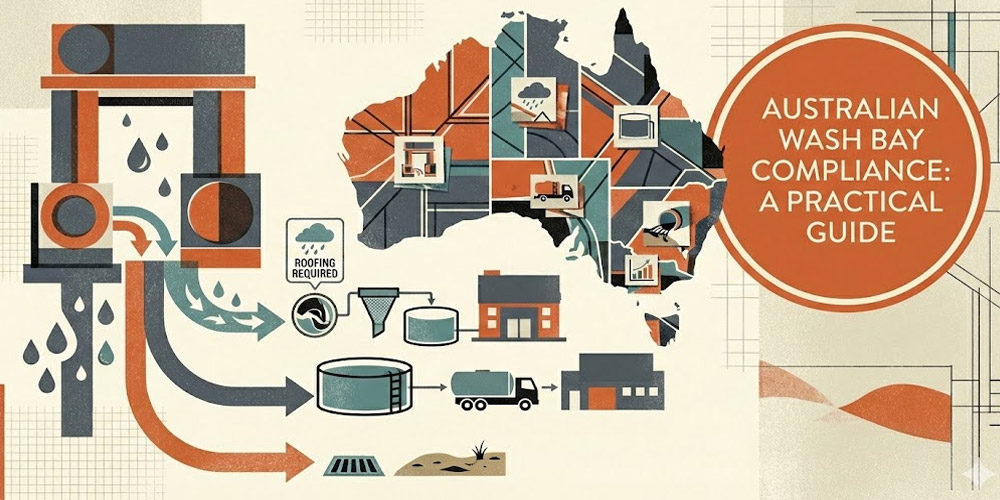
A practical, state-by-state guide for portable and permanent wash bays
Approval requirements for wash bays in Australia are driven by how wash water is managed, where it is discharged, and whether the activity constitutes a permanent site operation.
Understanding these factors early is the key to avoiding unnecessary approvals, enforcement action, or costly retrofits.
Three questions that determine approval requirements
Before looking at legislation, councils, or permits, answer these:
- Does any wash water discharge to sewer?
- Does any wash water reach stormwater or the ground?
- Is the wash bay a permanent site activity or a temporary / relocatable setup?
Every approval pathway in Australia is dependent on the answers to these questions.
1. Sewer discharge (highest regulatory burden)
If wash water is discharged to sewer:
- A Trade Waste Agreement with the local water authority is required
- Pre-treatment (typically oil–water separation) is required
- Rainwater exclusion is enforced (often via roofing or first-flush systems)
- Ongoing compliance, sampling, and fees apply
This pathway is regulated by:
- Sydney Water / SA Water / Water Corporation / SE Water etc.
- Enabling legislation such as the Protection of the Environment Operations Act 1997 (NSW), Water Supply (Safety and Reliability) Act 2008 (QLD), and equivalents in each state
Key point: Trade waste approval exists only to regulate sewer discharge.
2. Capture + holding tank + pump-out (no sewer discharge)
This pathway avoids sewer discharge approvals but does not remove environmental or council obligations.
If all wash water is captured and pumped to a holding tank for off-site removal by a licensed contractor, and nothing enters sewer, stormwater, or land:
- Trade waste approval is usually not required (because there is no sewer discharge)
- Regulatory responsibility shifts to:
- Local council
- Environmental protection laws
- Regulated waste transport requirements
This is a common and legitimate compliance pathway – but it is not unregulated.
What typically applies:
- Wash water is classified as regulated / liquid trade waste
- Waste must be removed by a licensed transporter
- Waste tracking dockets must be retained (often 3–5 years)
- Holding tank capacity must be sufficient to prevent overflow
- Systems must prevent stormwater contamination
Important: Using a holding tank avoids sewer approvals, but introduces ongoing operational compliance (pump-outs, records, contractor management).
3. Uncontrolled discharge (not compliant)
The following are not compliant in any Australian jurisdiction:
- Washing onto bare ground
- Washing into stormwater drains
- Allowing rainwater to mix with contaminated wash areas and escape site controls
These scenarios attract enforcement under state environmental protection laws regardless of whether a wash bay exists.
Does “portable” mean no council approval required?
No.
Portability is an operational benefit, not a regulatory exemption.
Councils assess:
- Land use activity, not just structure type
- Environmental risk, not just permanence
- Scale and intensity, not marketing labels
In many cases, installing a wash bay – portable or not can trigger:
- A change of use assessment (e.g. warehousing → vehicle washing)
- Planning or building approvals if structures, roofs, tanks, or containers are installed
- Environmental health conditions where wastewater is stored on site
This is why the assumption that portable wash bays are “exempt” is often misleading.
The roofing issue (why it matters)
Where sewer discharge is proposed, many councils and water authorities require wash bays to be roofed to prevent clean rainwater entering the sewer system.
Why this matters:
- Roofing can be a major cost driver
- Large or oversized equipment may make roofing impractical
- Alternatives (e.g. first-flush diversion systems) may be required and approved case-by-case
If you are trying to avoid roofing requirements, avoiding sewer discharge altogether is often the simplest path – provided wash water is fully captured and removed.
How approval responsibility differs by state
| State / Territory | Sewer Discharge Regulator | Who Oversees No-Discharge Systems |
|---|---|---|
| NSW (Sydney) | Sydney Water | Local council + EPA NSW |
| NSW (Regional) | Local council | Local council + EPA NSW |
| QLD | Local council | Local council + QLD DES (ERAs) |
| VIC | Water retailer | EPA Victoria (General Environmental Duty) |
| WA | Water Corporation | Local council + DWER |
| SA | SA Water | Local council + SA EPA |
| TAS | TasWater | Local council |
| ACT | Icon Water | ACT Government |
Note: This table indicates regulatory responsibility only. Whether approval is required still depends on discharge method, site conditions, and operational setup.
How to confirm what applies to your site
If you want certainty before installing:
Step 1 – Identify your local water authority
Search:"[Water authority name] trade waste wash bay"
This confirms whether sewer discharge would require approval (it almost always does).
Step 2 – Check your local council
Search:
"[Council name] wash bay""[Council name] trade waste""[Council name] vehicle washing"
Look for references to:
- change of use
- environmental health
- on-site wastewater
- liquid waste storage
Step 3 – Ask the right question
“We plan to install a wash bay where all wash water is captured and removed by a licensed waste contractor. There will be no sewer or stormwater discharge. Are any council approvals required for this setup?”
This avoids confusion and focuses regulators on the actual risk profile.
Common mistakes that cause compliance issues
- Installing holding tanks without overflow controls
- Failing to retain waste disposal records
- Allowing rainwater to mix with contaminated wash areas
- Over-engineering treatment when pump-out would suffice – or under-engineering where discharge is proposed
Approval requirements are highly site-specific. Assumptions based on structure type, marketing labels, or informal advice often result in compliance failures or unnecessary cost. Early clarification of discharge method and operational intent is the most reliable way to avoid rework, enforcement action, or retrofits.
How Trade Enviro can help
Trade Enviro supplies wash bay systems configured for Australian compliance pathways, including:
- Containment-only systems for pump-out operations
- Systems designed to integrate with holding tanks or treatment equipment
- Documentation used to support council or trade waste discussions
We focus on practical, site-appropriate setups that reduce approval risk without unnecessary civil works.